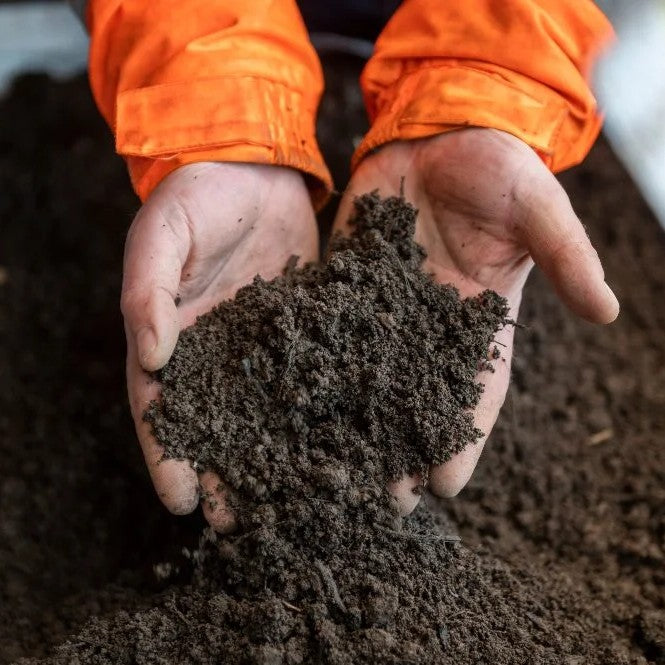
Rich, finished compost loaded with organic matter. Mix it into beds to boost nutrients, improve water retention, and build the kind of soil plants love.
Wonderful experience! They put the mulch exactly where we wanted. This mulch spread very easily and didn’t have the usual “mulch smell.” We will definitely use again!
Tell us what you're looking for
Thanks! We received your request.
Something went wrong. Please try again.
How Much Compost Do I Need?
One cubic yard of compost covers about 324 square feet at a one inch depth, which is the right depth for lawn top dressing. For beds, where you want two to three inches worked into the soil, plan on roughly 100 to 160 square feet per yard depending on the depth you choose. Measure your bed or lawn area first, then decide depth based on the project, not the other way around. Use our free compost calculator
What is a yard?
A yard is approximately 27 cubic feet. As a general guideline, one yard of material can cover an area of about 10 feet by 10 feet at a few inches deep.
We can't take orders for this right now. Tell us what you need and we'll get back to you.
What do you need?
Thanks! We received your request.
Something went wrong. Please try again.
Hand-picked local yards
4,000+ regional deliveries
Dedicated support
Why order through Mulch Mound
The best local compost, without the guesswork.
We hand-pick and partner with the best yards in your region, keep only the ones our buyers rate well, and back each load with our guarantee.
Mulch Mound Guarantee
If your compost isn't the quantity or quality you ordered, we'll make it right.
About this compost
Rich, finished compost loaded with organic matter. Mix it into beds to boost nutrients, improve water retention, and build the kind of soil plants love.
Wonderful experience! They put the mulch exactly where we wanted. This mulch spread very easily and didn’t have the usual “mulch smell.” We will definitely use again!
How Much Compost Do I Need?
One cubic yard of compost covers about 324 square feet at a one inch depth, which is the right depth for lawn top dressing. For beds, where you want two to three inches worked into the soil, plan on roughly 100 to 160 square feet per yard depending on the depth you choose. Measure your bed or lawn area first, then decide depth based on the project, not the other way around. Use our free compost calculator
What is a yard?
A yard is approximately 27 cubic feet. As a general guideline, one yard of material can cover an area of about 10 feet by 10 feet at a few inches deep.
Wonderful experience! They put the mulch exactly where we wanted. This mulch spread very easily and didn’t have the usual “mulch smell.” We will de...
Read full review
Wonderful experience! They put the mulch exactly where we wanted. This mulch spread very easily and didn’t have the usual “mulch smell.” We will definitely use again!
Placing an order online was so easy. Delivery was on time. When the driver realized we had a newly poured driveway they erred on the side of cautio...
Read full review
Placing an order online was so easy. Delivery was on time. When the driver realized we had a newly poured driveway they erred on the side of caution and opted not ti drive in it. The company even sent me a message explaining that call. Would recommend!
Compost pairs naturally with mulch on top once it is worked into beds, since the compost feeds the soil while mulch holds moisture and temperature above it. On lawns, many people follow a compost top dressing with grass seed or a light aeration pass while the soil is loose. If you are building new beds from scratch, a topsoil and compost blend gives you both structure and fertility from the start.
Do not pile compost more than three inches deep even in beds, since excess compost can actually tie up nitrogen temporarily as soil microbes work through it, which sets plants back rather than helping them. On the sandy loam common around Stony Brook, a thinner layer worked in well outperforms a thick layer left sitting on top. Think of it as a steady feeding program across a few seasons instead of a single heavy application.
Mulch Mound Pro Tip
The most common mistake with lawn top dressing is applying compost right before a heavy rain, which on sandy loam can wash the fine material into low spots before it settles in. Time it for a dry stretch of a few days if you can, especially in fall ahead of the Nov 5 average first frost, so the compost has a chance to work down before the ground cools and slows biological activity.
Mulch Mound Pro Tip
If you are amending several beds around a property, it is often more efficient to order one larger compost delivery and move it with a wheelbarrow than to order small amounts repeatedly. Compost also stretches further when paired with existing soil rather than replacing it entirely, so till it into what you have on your sandy loam base instead of trying to bury the native soil under a new layer.
Building Better Soil in Stony Brook
Stony Brook sits on sandy loam that drains fast, which means it also loses nutrients fast, especially through the shoulder seasons before and after the zone 7b frost dates. Compost tilled two to three inches into beds gives that soil something to hold onto, both moisture and fertility, instead of letting it wash straight through. For lawns, a thin one inch top dressing in spring or fall builds soil structure over a few seasons without smothering grass. This is a slow fix, not a one time dump, and the sandy base here rewards steady applications.
What Finished Compost Is
Finished compost is organic matter that has fully broken down into a dark, crumbly material with an earthy smell. It feeds soil life, improves structure, and helps beds hold water without staying soggy.
How Much to Apply
Work 1 to 2 inches into new beds, or topdress lawns with a quarter to half inch and rake it in. More is not better. Too thick a layer can smother roots instead of feeding them.
When to Apply
Spring and fall are both good windows. Spring applications feed the growing season ahead, and fall applications break down over winter so beds are ready at first thaw.
Frequently Asked Questions
Click a question to see the answer
Answer
What is compost actually made of and is it the same as topsoil or mulch?
Our compost is finished yard waste and food scrap material that has been turned and stabilized, not raw topsoil and not bark mulch. It is meant to feed soil biology and add structure, while topsoil is more about bulk fill and mulch sits on top to protect the surface. Many projects around Stony Brook use compost tilled into topsoil rather than as a replacement for it.
Answer
How many cubic yards of compost do I need for a 500 square foot lawn?
At a one inch top dressing depth, one cubic yard covers about 324 square feet, so a 500 square foot lawn needs a little more than one and a half cubic yards. Rounding up to two yards is reasonable since spreading rarely comes out perfectly even across the whole area.
Answer
When is the best time to apply compost, spring or fall?
Both work in this climate. Spring application after the Apr 15 last frost gives beds and lawns a boost heading into the growing season, while fall application before the Nov 5 first frost lets compost work into the soil over winter. Choose based on your project timeline rather than assuming one season is required.
Answer
Where will the delivery truck place the compost and do I need a special access point?
The truck drops the load at a driveway, curb, or other accessible spot you designate, since a full yard of compost is too heavy to move far by hand. Let us know at checkout if your access is tight, narrow, or has obstacles like a low tree or fence, so the load lands somewhere you can work with.
Answer
Should I use compost or topsoil for a new garden bed?
For a brand new bed, a blend works best, topsoil for bulk volume and compost mixed in for fertility and structure. Straight compost alone can be too rich and unstable as a growing medium on its own, especially over the sandy loam base common in Stony Brook, so pairing it with topsoil gives you a more balanced result.