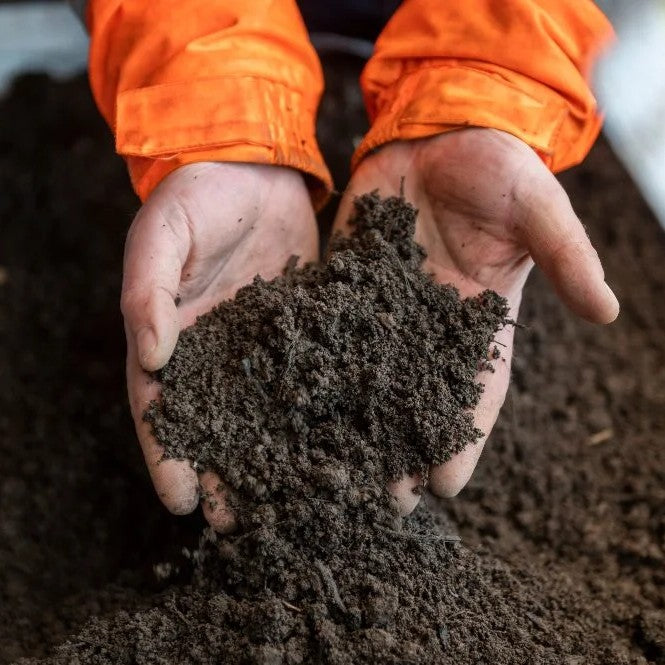
Finished screened compost, fully broken down and ready to work into beds. The general purpose choice for building soil that holds water and feeds roots.
First time going with this company for mulch and it was an efficient process from start to finish. Website was easy—I told them exactly where I wanted the mulch put on my driveway, and it was delivered perfectly when I got home from work the next day. Best deal around when I c...
Tell us what you're looking for
Thanks! We received your request.
Something went wrong. Please try again.
How Much Compost Do I Need?
One cubic yard of our compost covers about 324 square feet at a 1 inch depth, which is the right thickness for top dressing an established lawn. For bed work, plan on tilling in 2 to 3 inches, which covers roughly 108 to 162 square feet per yard depending on depth. Measure your lawn or bed footprint first, then match it to the depth you need rather than guessing at yardage. Use our free compost calculator
What is a Yard?
A yard is approximately 27 cubic feet. As a general guideline, one yard of material can cover an area of about 100-160 square feet at a 2-3 inch depth.
We can't take orders for this right now. Tell us what you need and we'll get back to you.
What do you need?
Thanks! We received your request.
Something went wrong. Please try again.
Hand-picked local yards
4,000+ regional deliveries
Dedicated support
Why order through Mulch Mound
The best local compost, without the guesswork.
We hand-pick and partner with the best yards in your region, keep only the ones our buyers rate well, and back each load with our guarantee.
Mulch Mound Guarantee
If your compost isn't the quantity or quality you ordered, we'll make it right.
About this compost
Finished screened compost, fully broken down and ready to work into beds. The general purpose choice for building soil that holds water and feeds roots.
First time going with this company for mulch and it was an efficient process from start to finish. Website was easy—I told them exactly where I wanted the mulch put on my driveway, and it was delivered perfectly when I got home from work the next day. Best deal around when I c...
How Much Compost Do I Need?
One cubic yard of our compost covers about 324 square feet at a 1 inch depth, which is the right thickness for top dressing an established lawn. For bed work, plan on tilling in 2 to 3 inches, which covers roughly 108 to 162 square feet per yard depending on depth. Measure your lawn or bed footprint first, then match it to the depth you need rather than guessing at yardage. Use our free compost calculator
What is a Yard?
A yard is approximately 27 cubic feet. As a general guideline, one yard of material can cover an area of about 100-160 square feet at a 2-3 inch depth.
First time going with this company for mulch and it was an efficient process from start to finish. Website was easy—I told them exactly where I wan...
Read full review
First time going with this company for mulch and it was an efficient process from start to finish. Website was easy—I told them exactly where I wanted the mulch put on my driveway, and it was delivered perfectly when I got home from work the next day. Best deal around when I compared it to competitors and I will definitely be becoming back.
Wonderful experience! They put the mulch exactly where we wanted. This mulch spread very easily and didn’t have the usual “mulch smell.” We will de...
Read full review
Wonderful experience! They put the mulch exactly where we wanted. This mulch spread very easily and didn’t have the usual “mulch smell.” We will definitely use again!
Compost pairs naturally with a topsoil layer on new beds, since the topsoil provides bulk while the compost brings the biology and nutrients. On lawns, many customers alternate compost top dressing with a sand-based topdressing mix to manage the sandy base without overdoing either one. If you are building new planting beds from scratch, ordering both together in one delivery saves a second trip.
In Cape Coral's sandy soil, resist the urge to till compost in deep. Two to three inches worked into the top layer of a planting bed does more good than the same volume buried a foot down, because that's where feeder roots actually live. Sand drains so fast that anything buried deep just leaches past the root zone before plants get to use it. Keep amendments shallow and let roots find them.
Mulch Mound Pro Tip
The most common mistake we see is piling on too much compost thinking it speeds things up. More is not better, excess nitrogen-rich compost can actually lock up other nutrients and throw off pH in a bed. Stick to 1 inch for lawn top dressing and 2 to 3 inches tilled into beds, then let it work down naturally rather than reapplying right away.
Mulch Mound Pro Tip
Compost sells well here in both spring and fall, and either window works because Cape Coral rarely sees a hard freeze that would stall soil biology. Fall application gives beds a head start before winter color plantings, while spring application feeds up warm season growth. Pairing a compost order with topsoil in the same delivery is more efficient than two separate trips if you are building new beds.
Building Better Soil in Cape Coral
Sandy soil is the defining fact of gardening in Cape Coral, and straight sand has almost no capacity to hold water or nutrients near the root zone. Compost worked into beds builds the organic structure that sand lacks, giving roots something to hold onto between waterings. With zone 10a growing conditions running warm most of the year, plants pull hard on soil nutrients, and compost restocks that supply gradually instead of in a spike. Whether you are prepping beds near the canal lots or top dressing a lawn near the Yacht Club area, this is the fix for soil that drains before plants can use what you feed them.
What Finished Compost Is
Finished compost is organic matter that has fully broken down into a dark, crumbly material with an earthy smell. It feeds soil life, improves structure, and helps beds hold water without staying soggy.
How Much to Apply
Work 1 to 2 inches into new beds, or topdress lawns with a quarter to half inch and rake it in. More is not better. Too thick a layer can smother roots instead of feeding them.
When to Apply
Spring and fall are both good windows. Spring applications feed the growing season ahead, and fall applications break down over winter so beds are ready at first thaw.
Frequently Asked Questions
Click a question to see the answer
Answer
Will compost actually help my sandy Cape Coral soil hold water better?
Yes, that is its main job here. Sandy soil drains too fast to hold nutrients or moisture near roots, and compost adds organic matter that acts like a sponge in that sand. Tilling 2 to 3 inches into a bed noticeably slows drainage and gives roots more time to take up water and nutrients between irrigation cycles.
Answer
How many cubic yards do I need for a 1,000 square foot lawn top dressing?
At a 1 inch depth, one cubic yard covers about 324 square feet, so a 1,000 square foot lawn needs a little over 3 cubic yards. Round up slightly rather than short, since spreading thin and even matters more than stretching material to the exact edge.
Answer
Is spring or fall a better time to add compost in Cape Coral?
Both work, since our mild winters mean soil biology does not really shut down here. Fall application sets up beds before winter color plantings go in, while spring application supports the flush of warm season growth. Pick whichever lines up with your planting schedule rather than worrying about a strict seasonal window.
Answer
Where will the compost be placed when it is delivered?
We drop the load wherever you have space for the truck to dump it, usually a driveway or the edge of a work area. Clear that spot ahead of time and have a wheelbarrow route mapped out, since fresh compost is heavy and you will be moving it by hand or cart from the pile.
Answer
Should I use compost or topsoil for new planting beds?
They do different jobs. Topsoil provides bulk and a base layer, while compost brings organic matter and nutrients that sandy Cape Coral soil is missing. Most new beds do best with a topsoil base and compost tilled into the top few inches, and ordering both in one delivery covers the job without a second trip.