I couldn't be happier with the speed and quality of the mulch delivery service of Mulch Mound. Every detail from ordering, to communication with on time delivery, to perfect product placement was amazing. I needed more and I got it within 2 hours! I'm never doing this with ba...
Tell us what you're looking for
Thanks! We received your request.
Something went wrong. Please try again.
How Much Material Do I Need?
Three inches is the sweet spot for Hudson beds, enough to suppress weeds and hold moisture through August without smothering roots in our moisture retentive silt loam. Keep tree rings at two to three inches and never mound mulch against trunks.
Use our free mulch calculator
What is a yard?
A yard is approximately 27 cubic feet. As a general guideline, one yard of material can cover an area of about 100-160 square feet at a 2-3 inch depth.
I couldn't be happier with the speed and quality of the mulch delivery service of Mulch Mound. Every detail from ordering, to communication with on time delivery, to perfect product placement was amazing. I needed more and I got it within 2 hours! I'm never doing this with ba...
How Much Material Do I Need?
Three inches is the sweet spot for Hudson beds, enough to suppress weeds and hold moisture through August without smothering roots in our moisture retentive silt loam. Keep tree rings at two to three inches and never mound mulch against trunks.
Use our free mulch calculator
What is a yard?
A yard is approximately 27 cubic feet. As a general guideline, one yard of material can cover an area of about 100-160 square feet at a 2-3 inch depth.
I couldn't be happier with the speed and quality of the mulch delivery service of Mulch Mound. Every detail from ordering, to communication with on...
Read full review
I couldn't be happier with the speed and quality of the mulch delivery service of Mulch Mound. Every detail from ordering, to communication with on time delivery, to perfect product placement was amazing. I needed more and I got it within 2 hours! I'm never doing this with bags again.
We had a great experience today. This was our first time using Mulch Mound, and I found the price competitive and the online ordering very easy. ...
Read full review
We had a great experience today. This was our first time using Mulch Mound, and I found the price competitive and the online ordering very easy. We are impressed with the quality of the mulch, too! It is covering well - a great value!
Measure each bed separately rather than guessing at one lump total, since Hudson properties tend to have several odd shaped beds around a foundation, a mailbox, and a tree ring. For curved beds, take an average width and multiply by the length, which gets you within a few percent. Round your final number up to the nearest half yard so you are not short on the last strip.
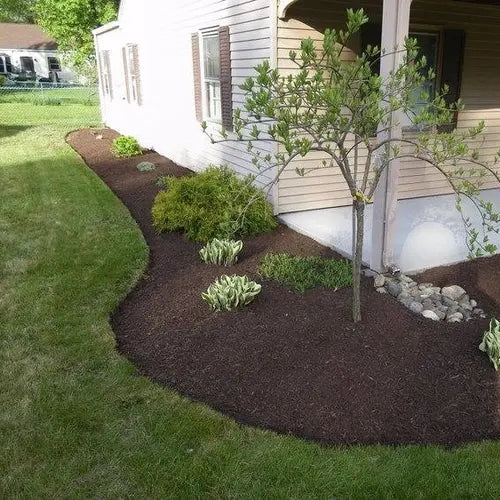
Mulch vs. No Mulch: The Difference
Hudson gets around 43 inches of rain a year spread over a long, humid growing season, which means microbes stay active in the mulch layer from April well past the October 15 first frost. That constant activity breaks organic mulch down faster here than in drier parts of the country, so expect real volume loss each year. The tradeoff is that everything breaking down is feeding your silt loam, which is exactly what most Hudson beds need.
Before
After
Best Mulch Choice for Hudson Lawns
Most yards in the Hudson area sit on type of soil. Hudson's silt loam holds water beautifully but compacts under foot traffic and heavy rain, and once compacted it drains slowly and starves roots of oxygen. Beds that sit wet into late spring are the most common plant health complaint we hear from Hudson homeowners.
Hardwood Mulch
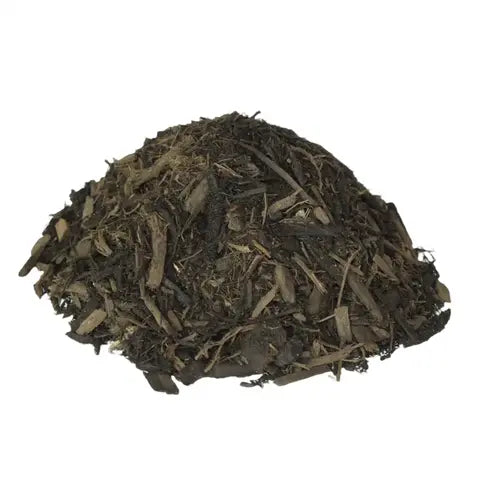
Double ground hardwood mulch solves both ends of that problem in Hudson. It cushions rainfall impact so the silt loam never seals over, and as it decomposes it feeds organic matter and earthworm activity into the top few inches, opening pore space that improves drainage in spring and moisture holding in midsummer.
Complete Your Outdoor Mulch Project
Pair your mulch with a yard of compost worked into the top few inches for tired Hudson beds, and add steel or spade cut edging to keep mulch out of the lawn. Decorative stone works well for downspout splash zones where mulch tends to float away.
Mulch Mound Pro Tip
Edge before you mulch, not after. Cut a clean four inch deep trench along the bed line with a spade, angling the wall back toward the plants. On Hudson's silt loam that trench holds its shape for a full season and acts as a small catch basin during our heavy spring rains, keeping mulch inside the bed instead of floating onto the lawn and driveway. It also gives the finished bed a sharp, defined line that makes the mulch itself look twice as good.
Mulch Mound Pro Tip
Water your beds thoroughly the day before mulch arrives if the forecast has been dry. Hudson silt loam forms a surface crust in July that sheds water, and dry mulch spread over dry, crusted soil can shed rain for weeks before it starts letting moisture through. Wetting the soil first, then mulching, locks that moisture in and gives roots a reservoir to draw from through the hottest stretch of the summer.
Mulch Mound Pro Tip
Keep mulch three inches away from trunks and stems. Volcano mulching around maples and ornamental pears is common across Hudson and it traps moisture against bark, invites rodents over winter, and encourages girdling roots. Pull the mulch back to expose the root flare, the point where the trunk widens at the ground. Trees mulched correctly in Hudson's clay heavy subsoil establish faster and hold up better in wind and ice storms.
Frequently Asked Questions
Click a question to see the answer
Answer
When should I mulch my beds in Hudson?
Wait until the silt loam has warmed, usually late April into mid May near Hudson's May 5 average last frost. Mulching too early over cold, saturated soil slows root activity and can keep beds soggy. A second light top dress in early October, before the October 15 first frost, helps insulate perennials through winter.
Answer
How often do I need to replace mulch here?
With 43 inches of annual rainfall and warm, humid Hudson summers, hardwood mulch decomposes noticeably in a single season. Most Hudson homeowners top dress one to one and a half inches each spring rather than replacing everything. Plan on a full cleanout and reset every three or four years once the old layer becomes matted.
Answer
Will mulch wash off my sloped front yard during spring storms?
Fine, uniform mulches float, which is a real problem on the graded lots common through Hudson's newer neighborhoods. Choose a shredded hardwood with stringy fibers that knit together and grip the slope. On grades steeper than about ten percent, edge the bed with a shallow trench so runoff has somewhere to go besides the driveway.
Answer
Does mulch cause the slugs and fungus I see in my shady beds?
Hudson's humid summers and heavy tree canopy already create ideal slug conditions, and mulch piled too deep makes it worse. Keep the layer at two to three inches, pull it back a couple of inches from stems, and rake the surface once midsummer to break up any crust. That air exchange makes a big difference in shaded beds along older Hudson streets.
Answer
Is dyed mulch safe around my vegetable garden and pets?
The colorants used in quality dyed mulch are iron oxide and carbon based and are not a concern for pets or people. Still, most Hudson gardeners keep dyed products in ornamental beds and use natural double ground hardwood or straw in vegetable rows, where the goal is feeding the silt loam rather than holding color.
Answer
Can I just mulch right over last year's layer?
Yes, if the existing layer has thinned to about an inch. Hudson's rainfall breaks mulch down fast, so most beds are ready for a top dress each spring. If you find a compacted mat that water beads on top of, break it up with a cultivating fork first so spring rain reaches the silt loam underneath.
Answer
How much mulch do I need for a typical Hudson front bed?
A common Hudson foundation bed runs about 200 to 350 square feet. At a three inch depth, that is roughly two to three and a half cubic yards. One cubic yard covers about 108 square feet at three inches deep, so measure your beds, multiply length by width, and divide the total by 108.
The Unique Landscape of Hudson
Hudson sits in growing zone 6b on Summit County silt loam, a soil that holds moisture well but crusts over and sheds water once it dries out in a July heat stretch. With roughly 43 inches of rain a year, much of it arriving in heavy spring downpours, bare beds in Hudson wash out toward the sidewalk and leave shallow roots exposed. A layer of mulch buffers that impact, keeps the silt loam from sealing shut, and holds the steady moisture that maples, hydrangeas, and hostas around town depend on. It also narrows the freeze and thaw swings that push perennials out of the ground between the October 15 first frost and the May 5 last frost. At 1066 feet of elevation, Hudson beds cool off fast on clear autumn nights, and mulch keeps root zone temperatures far more stable than bare soil does. For most Hudson properties, mulch is the single cheapest thing you can add that improves both plant health and curb appeal.