


Great service. We ordered topsoil from Mulch Mound and the best experience. Thank you so much!
About this compost
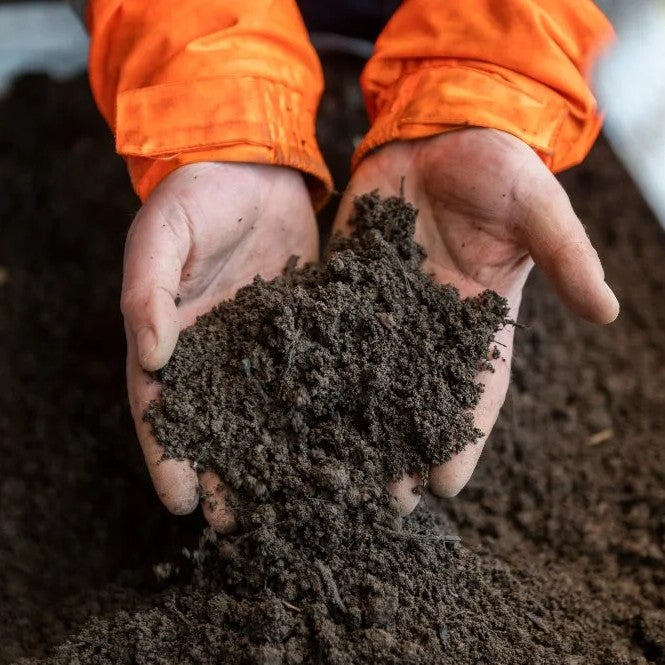
Rich, finished compost loaded with organic matter. Mix it into beds to boost nutrients, improve water retention, and build the kind of soil plants love.
Great service. We ordered topsoil from Mulch Mound and the best experience. Thank you so much!
Tell us what you're looking for
Thanks! We received your request.
Something went wrong. Please try again.
How Much Compost Do I Need?
How Much Compost Do I Need?
One cubic yard of compost covers about 324 square feet at a 1 inch depth, which is the right amount for top dressing a lawn. For garden beds, you will till in 2 to 3 inches, so figure roughly a third of that coverage per yard, closer to 108 to 160 square feet depending on depth. Measure your bed or lawn area first, then match it to the depth you are installing rather than guessing.
Use our free compost calculator
What is a yards?
What is a yards?
FAQs
FAQs
Norton Shores Compost Delivery
Norton Shores Compost Delivery
Regular price
$42.00
per
yards
Regular price
Sale price
$42.00
Unit price
per
Shipping calculated at checkout.
Minimum of 3 yards
Couldn't load pickup availability
Not currently available
We can't take orders for this right now. Tell us what you need and we'll get back to you.
Hand-picked local yards
4,000+ regional deliveries
Dedicated support
Why order through Mulch Mound
The best local compost, without the guesswork.
We hand-pick and partner with the best yards in your region, keep only the ones our buyers rate well, and back each load with our guarantee.
Mulch Mound Guarantee
If your compost isn't the quantity or quality you ordered, we'll make it right.
About this compost
Rich, finished compost loaded with organic matter. Mix it into beds to boost nutrients, improve water retention, and build the kind of soil plants love.
Great service. We ordered topsoil from Mulch Mound and the best experience. Thank you so much!
How Much Compost Do I Need?
How Much Compost Do I Need?
One cubic yard of compost covers about 324 square feet at a 1 inch depth, which is the right amount for top dressing a lawn. For garden beds, you will till in 2 to 3 inches, so figure roughly a third of that coverage per yard, closer to 108 to 160 square feet depending on depth. Measure your bed or lawn area first, then match it to the depth you are installing rather than guessing.
Use our free compost calculator
What is a yards?
What is a yards?
FAQs
FAQs
Tell us what you're looking for
Thanks! We received your request.
Something went wrong. Please try again.

How It Works
Getting started is easy — just follow these simple steps
1
Choose your quantity
Adjust the quantity to match your project. One cubic yard covers about 100 to 160 square feet at a 2 to 3 inch depth.
2
Select your delivery date
Select a delivery date you'd like for the product to be dropped off at your home
3
Sit back and wait
Sit back, wait, and let us work our magic to make sure the highest quality product is delivered to your driveway.

One of the easiest customer service experiences I've had in a long time! Mulch Mound made it so simple. After putting it off for a while, I looked ...
Read full review
One of the easiest customer service experiences I've had in a long time! Mulch Mound made it so simple. After putting it off for a while, I looked at the weather and knew I needed to get to mulching ASAP before the rain came if I didn't want to wait another week. I put my order in for the next day online and they came right at 9 AM. The employee who dropped off the mulch did a great job, putting it right on the tarp I laid out, she even made sure none of it got on the yard and double checked the truck bed to make sure it all came out. The mulch was exactly what I needed and arrived right on time.

We have always spread our own mulch for the past 24 years. This was our first time with the Mulch Mound - things I liked: they have online ordering...
Read full review
We have always spread our own mulch for the past 24 years. This was our first time with the Mulch Mound - things I liked: they have online ordering and provide a digital receipt which means you can remember how much you ordered (I always forget for the next year!), they were on time, they were able to deliver in 48 hours, they were generous with the portion (we got 9 yards and it felt like a FULL nine yards!), the driver was polite! We have ordered from reputable places, and there is always a little trash in the mulch. The mulch we recv'd from Mulch Mound had barely any... we were pleasant surprised!!! Color was great! Not to mention - the price was competitive and LOWER than other mulch places around. We will use again !! Highly recommend! Thanks Mulch Mound!
Complete Your Outdoor Project
Compost pairs naturally with topsoil on beds that need real rebuilding, since the topsoil provides bulk and the compost provides the biology. For lawns, a lot of Norton Shores customers top dress with compost after aerating, which helps it work down into sandy turf instead of sitting on top. Mulch on top of a compost-amended bed helps hold moisture that sandy loam would otherwise lose fast.


Service area
Areas we deliver compost in Norton Shores, Michigan
Mulch Mound Pro Tip
Sandy loam around Norton Shores drains so fast that compost tilled in shallow can wash down past the root zone before it does much good. Go the full 2 to 3 inches in beds, not the minimum, and till it in rather than layering it on top. On lawns, stick to 1 inch and rake it into the turf canopy so it reaches soil contact instead of smothering grass blades.
Mulch Mound Pro Tip
The biggest mistake we see is treating compost like mulch and piling it on thick expecting faster results. More than 3 inches in a bed can actually lock up nitrogen temporarily as microbes work through the extra organic matter, which sets plants back rather than helping them. Thin applications, repeated over a couple seasons, build better soil than one heavy dump.
Mulch Mound Pro Tip
Compost sells in both spring and fall here, and each season has an advantage. Fall gives it a few months to integrate before planting season, which suits beds going in next to Hoffmaster-adjacent properties with sandier soil. Spring works better if you are top dressing lawns right before the growing season kicks in around last frost in mid May. Neither season is wrong, just match it to what you are planting.
Building Better Soil in Norton Shores
Sandy loam near the lakeshore drains quickly, which is great for avoiding soggy spots but rough on nutrient retention, especially with the sandy pockets common closer to the dunes around Hoffmaster. Compost worked into that soil adds organic matter that slows drainage just enough and gives roots something to grab. In zone 6b, fall applications have time to break down before the ground freezes around mid October, and spring applications get plants going before the last frost clears in May. Either way, it is building soil structure that sandy ground here does not build on its own.
What Finished Compost Is
Finished compost is organic matter that has fully broken down into a dark, crumbly material with an earthy smell. It feeds soil life, improves structure, and helps beds hold water without staying soggy.
How Much to Apply
Work 1 to 2 inches into new beds, or topdress lawns with a quarter to half inch and rake it in. More is not better. Too thick a layer can smother roots instead of feeding them.
When to Apply
Spring and fall are both good windows. Spring applications feed the growing season ahead, and fall applications break down over winter so beds are ready at first thaw.