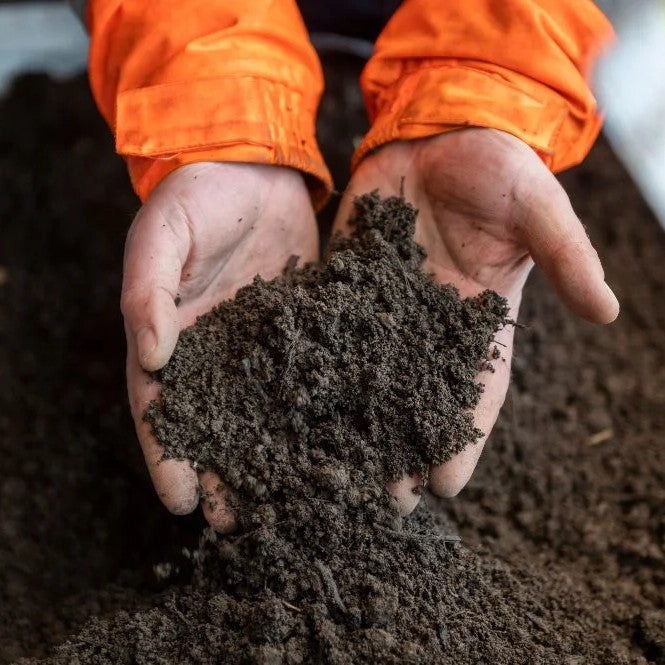
About this compost

Finished screened compost, fully broken down and ready to work into beds. The general purpose choice for building soil that holds water and feeds roots.

Really appreciate the care and follow thru that this company had with our order. A hiccup came up but they were quick to respond and address all concerns, which made our garden day a success! Thank you for your prompt care.

One cubic yard of compost covers about 324 square feet at a 1 inch depth, which is the right amount for lawn top dressing. If you're amending a bed and want 2 to 3 inches worked into the soil, figure roughly a third to a half of that coverage per yard, since the material goes down thicker. Measure your bed or lawn area first, then decide whether you're top dressing or tilling, since that changes how far a yard actually goes.

A yard is approximately 27 cubic feet. As a general guideline, one yard of material can cover an area of about 100-160 square feet at a 2-3 inch depth.

Odessa Compost Delivery

Odessa Compost Delivery

4.7
137 reviews
Regular price $60.00 per Yard
Regular price Sale price $60.00
Sale Sold out
Shipping calculated at checkout.
Type
Size
Hand-picked local yards
4,000+ regional deliveries
Dedicated support
Why order through Mulch Mound

The best local compost, without the guesswork.

We hand-pick and partner with the best yards in your region, keep only the ones our buyers rate well, and back each load with our guarantee.

Mulch Mound Guarantee

If your compost isn't the quantity or quality you ordered, we'll make it right.

About this compost

Finished screened compost, fully broken down and ready to work into beds. The general purpose choice for building soil that holds water and feeds roots.

Really appreciate the care and follow thru that this company had with our order. A hiccup came up but they were quick to respond and address all concerns, which made our garden day a success! Thank you for your prompt care.

One cubic yard of compost covers about 324 square feet at a 1 inch depth, which is the right amount for lawn top dressing. If you're amending a bed and want 2 to 3 inches worked into the soil, figure roughly a third to a half of that coverage per yard, since the material goes down thicker. Measure your bed or lawn area first, then decide whether you're top dressing or tilling, since that changes how far a yard actually goes.

A yard is approximately 27 cubic feet. As a general guideline, one yard of material can cover an area of about 100-160 square feet at a 2-3 inch depth.

View full details

How It Works

Getting started is easy — just follow these simple steps

1

Choose your quantity

Adjust the quantity to match your project. One cubic yard covers about 100 to 160 square feet at a 2 to 3 inch depth.

2

Select your delivery date

Select a delivery date you'd like for the product to be dropped off at your home

3

Sit back and wait

Sit back, wait, and let us work our magic to make sure the highest quality product is delivered to your driveway.

From The Mouths of Odessa Folks

4.7
out of 5 based on 137 reviews
Google Reviews

Complete Your Outdoor Project

Compost pairs naturally with a topsoil order if you're building up a bed from scratch, and with mulch on top once the compost is worked in, since the mulch holds moisture over ground that now has something to retain it. In sandy loam like Odessa's, that combination does more for a new bed than either material on its own.

Map of the compost delivery area around Odessa, Texas

Service area

Areas we deliver compost in Odessa, Texas

Mulch Mound Pro Tip

In Odessa's sandy loam, compost worked in shallow does more good than compost buried deep. Tilling 2 to 3 inches into the top layer of soil lets roots find it right away, while dumping it deeper just wastes material below where anything is actively growing. For lawns, stick to a thin 1 inch top dress and let rain or irrigation carry it down naturally instead of raking it in hard.

Mulch Mound Pro Tip

Compost breaks down fastest with moisture and warmth, so timing matters more here than in wetter climates. Apply it right before your spring green up around April or in fall before the Nov 12 frost, when temperatures are still mild enough for microbial activity but you're not fighting summer evaporation. Applying in the peak of a west Texas summer means a lot of that benefit dries out before it ever reaches the roots.

Mulch Mound Pro Tip

If you're building a new bed in Odessa's sandy loam, compost does more per yard when it's tilled rather than layered on top and left. Mixing it through the top 6 inches of native soil spreads the organic matter where roots actually grow, instead of creating a thin rich layer sitting over sand that still drains too fast underneath.

Building Better Soil in Odessa

Sandy loam around Odessa lets water and nutrients pass through quickly, which is efficient for drainage but rough on anything trying to establish roots, especially through a Zone 8a summer that pushes plants hard before the Nov 12 frost finally slows things down. Compost worked into that soil adds the organic matter sand doesn't have, giving roots something to hold onto and slowing down how fast water moves past them. It's common here to see beds and lawns that look thin by midsummer simply because the soil has nothing left to offer after spring growth. A couple inches of compost tilled in before planting season, or top dressed on lawns coming out of winter dormancy, makes a real difference in how the ground performs through the heat.

What Finished Compost Is

Finished compost is organic matter that has fully broken down into a dark, crumbly material with an earthy smell. It feeds soil life, improves structure, and helps beds hold water without staying soggy.

How Much to Apply

Work 1 to 2 inches into new beds, or topdress lawns with a quarter to half inch and rake it in. More is not better. Too thick a layer can smother roots instead of feeding them.

When to Apply

Spring and fall are both good windows. Spring applications feed the growing season ahead, and fall applications break down over winter so beds are ready at first thaw.

Frequently Asked Questions

Click a question to see the answer

Answer

Will compost actually help my lawn in this sandy soil, or do I need something else first?

Compost is exactly what sandy loam lawns need here, since the soil lacks the organic matter to hold water and nutrients near the roots. A 1 inch top dress worked in lightly gives grass something to draw from through the hot months. You don't need to replace the soil, just build it up gradually with compost applications.

Answer

How many cubic yards of compost do I need for a 1,000 square foot bed?

At a 2 inch depth for bed amending, one cubic yard covers roughly 160 square feet, so a 1,000 square foot bed needs about 6 cubic yards. If you're only tilling in 1 inch, that same yard covers about 324 square feet, so you'd need closer to 3 yards for the same area.

Answer

Should I apply compost in spring or fall around here?

Both work, and compost sells well in both seasons in Odessa. Spring application ahead of the Apr 8 last frost sets beds up for the growing season, while fall application before Nov 12 gives lawns a boost heading into dormancy. Pick whichever matches your project timing rather than waiting for a specific season.

Answer

Where will the compost be dropped and do I need to be home?

You'll choose the drop location at checkout, typically a driveway or the spot closest to your work area. You don't need to be home, but the space should be clear and accessible so the truck can tip the load without driving over landscaping or curbs.

Answer

What's the difference between compost and topsoil for my project?

Compost is decomposed organic matter meant to amend and feed existing soil, while topsoil is more about building volume and structure for new beds or grading. In Odessa's sandy loam, most projects benefit from topsoil to build the base and compost mixed in to add the organic matter the sand is missing.

More delivery around Odessa, Texas

All Odessa, Texas landscape supply